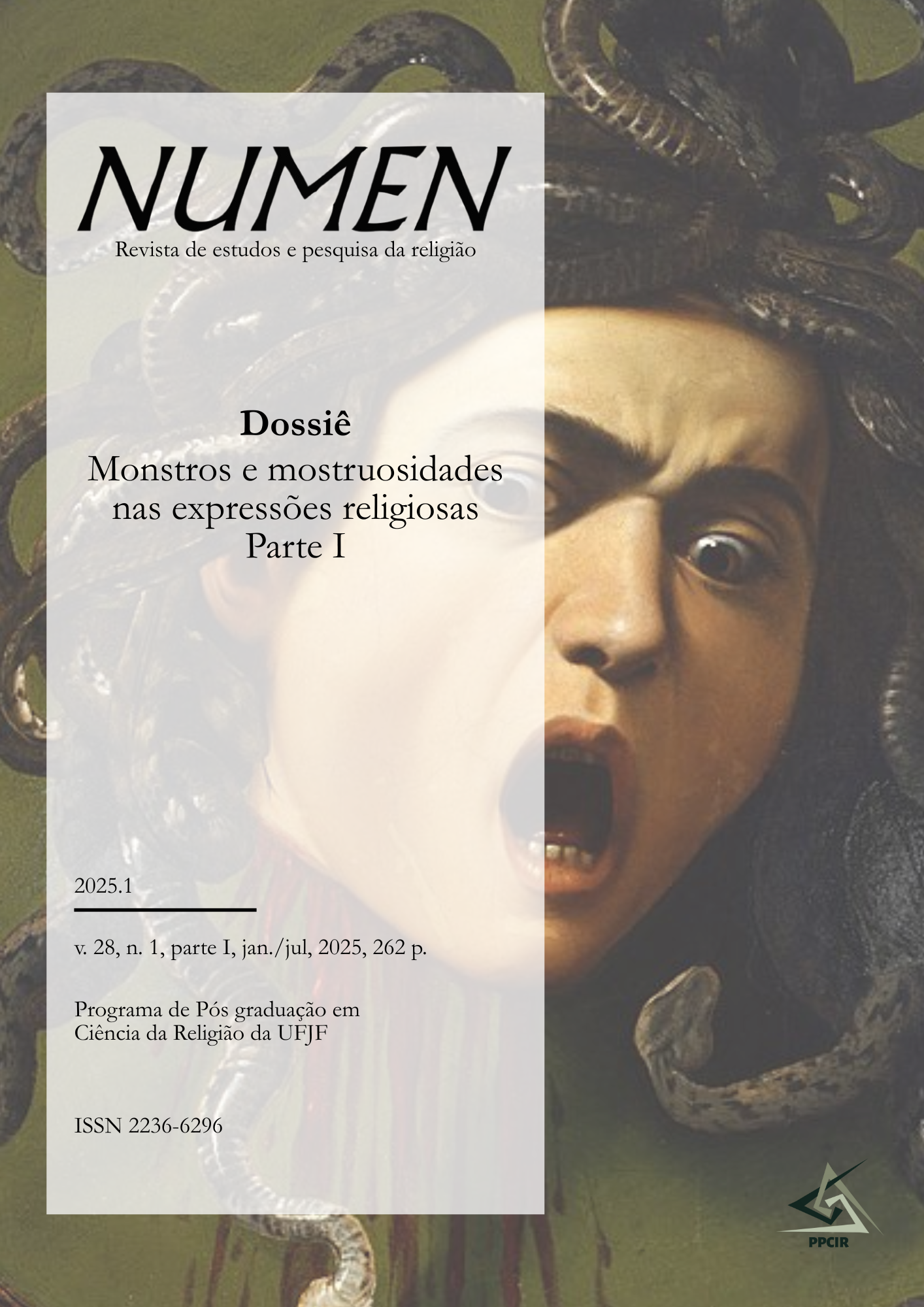
Monstrosity and radical ecology in Revelation 12
DOI:
https://doi.org/10.34019/2236-6296.2025.v28.48987Keywords:
Revelation of John, Monstrosity, Hybridism, Mythopoetics, Religion and EcologyAbstract
This article interprets the vision of the “woman clothed with the sun” in Revelation 12 from the perspective of the theory of monstrosity. In ancient and medieval commentators, the allegorical interpretation prevails, associating the text with Zion, the church, or Mary. Modern exegesis, although it rejects the allegorical interpretation, also tends to interpret women in ecclesiological terms. The feminist interpretation, attentive to the images of the feminine in the text, questions patriarchal assumptions, but ends up classifying the text in terms of the binomial: liberating or oppressive. From the perspective of the theory of monstrosity, the formal elements of mythopoetic visions and narratives are valued. In this way, it is possible to maintain the multivalent text, valuing the structural indeterminacy, which allows multiple appropriations for the most diverse contexts. The woman “clothed with the sun”, beyond the dualistic model to which she is subjected, presents herself as a connective image of God, hybrid and border-crossing, radically ecological.
Downloads
References
A Bíblia: Novo Testamento. São Paulo: Paulinas, 2015.
ARLÉS, Cesáreo. Comentario al Apocalipsis. Madrid: Ciudad Nueva, 1994.
BEAL, Timothy K. Religion and its Monsters. New York: Routledge, 2002.
BEATO de LIÉBANA, Obras completas y complementarias I y II. Madrid: Biblioteca de Autores Cristianos, 2004.
BERGER, Klaus. Die Apocalypse des Johannes Kommentar. Teilband 2: Apk 11-22. Freiburg: Herder, 2017.
COHEN, Jeffrey Jerome (ed.). Monster Theory. Reading Culture. Minneapolis: University of Minnesota Press, 1996.
COHEN, Jeffrey Jerome. A cultura dos monstros: sete teses, in: DONALD, James (et alii). A pedagogia dos monstros. Os prazeres e as perigos da confusão das fronteiras. Belo Horizonte: Autêntica, 2020, p. 23-60.
COLLINS, Adela Yarbro. The Combat Myth in the Book of Revelation. Eugene: Wipf & Stock Publishers, 2001.
ECUMENIO. Comentário sobre el Apocalipsis. Madrid: Ciudad Nueva, 2008.
EILBERG-SCHWARTZ, Howard. The Savage in Judaism. An Anthropology of Israelite Religion and Ancient Judaism. Bloomington/Indianapolis: Indiana University Press, 1990.
GILMORE, David D. Monsters. Evil Beings, Mythical Beasts, and All Manner of Imaginary Terrors. Philadelphia: University of Pennsylvania Press, 2003.
HONGISTO, Leif. Experiencing the Apocalypse at the Limits of Alterity. Leiden: Brill, 2010.
HUBER, Lynn R. Thinking and Seeing with Women in Revelation. London: Bloomsbury and T&Tclark, 2013.
Hylen, Susan E. Feminist Interpretation of Revelation. In: KOESTER, Craig (ed.). The Oxford Handbook of The Book of Revelation. Oxford: Oxford University Press, 2020, p. 467-482.
KOESTER, Carig R. Revelation. A New Translation with Introduction and Commentary (The Anchor Bible Yale Bible). New Haven: Yale University Press, 2014.
KOVACS, Judith & ROWLAND, Christopher. Revelation: The Apocalypse of Jesus Christ. Oxford: Blackwell, 2004.
LEE, Dorothy. The Heavenly Woman and the Dragon. Rereadings of Revelation 12. In: DEVLIN-GLASS, Frances; McCREEDEN, Lyn. Feminist Poetics of the Sacred. Creative Suspicions. Oxford: Oxford University Press, 2001, p. 198-220.
LÉVI-STRAUSS, Claude. A estrutura dos mitos. In: Antropologia estrutural. São Paulo: Cosacnaif, 2008, p. 221-248.
MACUMBER, Heather. Recovering the Monstrous in Revelation. Lanham: Lexington Books/Fortress Academic, 2021.
MOORE, Stephen D. Untold Tales from the Book of Revelation. Sex, Gender, Empire and Ecology. Atlanta: SBL Press, 2014.
MÜLLER, Ulrich B. Die Offenbarung des Johannes. Ökumenischer Taschenbuch-Kommentar zum Neuen Testament 10. Gütersloh: Gütersloher Verlagshaus Mohn, 1984.
NOGUEIRA, Paulo. Religião e poder no cristianismo primitivo. São Paulo: Paulus, 2020.
NOGUEIRA, Paulo. Taxonomia dos monstros no cristianismo primitivo. Caminhos, Goiânia, v.22, n.2, p. 542-557.
PIPPIN, Tina. Apocalyptic Bodies. The Biblical End of the World in Text and Image. London/New York: Routledge, 1999.
WEINRICH, William C. Apocalipsis, La Bíblia comentada por los Padres de la Iglesia. Nuevo Testamento 12. Madrid: Ciudad Nueva, 2010.
Downloads
Published
How to Cite
Issue
Section
License
Direito Autoral e de Exoneração de Responsabilidade Editorial
O envio de artigo implica a cessão dos direitos de publicação à Numen. Ao submeterem o manuscrito, os autores declaram-se titulares dos direitos autorais da obra. Os artigos aprovados são publicados sob a licença Creative Commons Atribuição (CC BY 4.0). Esta licença permite o compartilhamento, cópia e redistribuição do material em qualquer suporte ou formato, bem como sua adaptação para qualquer fim, inclusive comercial, desde que seja atribuído o devido crédito aos autores originais e à Revista NUMEN como veículo de publicação original.
Os artigos publicados em Numen são de total responsabilidade dos respectivos autores e autoras.
O conteúdo científico, opiniões, dados, conceitos e posicionamentos expressos nos artigos publicados são de inteira e exclusiva responsabilidade de seus respectivos autores. Por conseguinte, cumpre esclarecer que:
- A competência da equipe editorial restringe-se à chancela do processo de avaliação positiva.
- A homologação dos pareceres favoráveis vincula a revista estritamente ao ato técnico da publicação.
- A revista exime-se de qualquer responsabilidade civil, penal, autoral ou ideológica sobre o teor das obras. Os artigos publicados na Revista NUMEN são de inteira e exclusiva responsabilidade civil, penal e acadêmica de seus autores. O processo editorial adota o sistema de avaliação cega por pares (double-blind peer review). A competência da revista limita-se a homologar a avaliação positiva dos pareceristas externos e executar o ato técnico da publicação, eximindo-se de qualquer responsabilidade sobre o conteúdo, opiniões ou dados vertidos na obra.
- Eventuais litígios ou contestações sobre o conteúdo deverão ser direcionados diretamente aos submissores do texto.
Política de Prevenção ao Plágio
Os autores garantem a total originalidade do manuscrito, sendo terminantemente vedados:
- Plágio direto ou parcial: Cópia de textos de terceiros sem a devida identificação e citação bibliográfica.
- Autoplágio: Reutilização massiva de textos próprios já publicados, sem o ineditismo exigido pela revista.
- Fraude científica: Fabricação ou manipulação de dados, gráficos e resultados.
Citações e Conteúdos de Redes Sociais
O uso de dados, imagens, textos ou quaisquer conteúdos extraídos de plataformas de redes sociais (como Instagram, TikTok, X/Twitter, Facebook, LinkedIn, entre outras) deve observar rigorosamente os seguintes critérios jurídicos e técnicos:
- Direito à Privacidade e Anonimização: É obrigação dos autores anonimizar dados pessoais, nomes, fotos e perfis de usuários que não sejam figuras públicas, garantindo o direito à privacidade e a proteção de dados (LGPD).
- Direito de Imagem e Propriedade Intelectual: A reprodução de capturas de tela (prints), fotografias ou obras artísticas publicadas em redes sociais exige a autorização expressa do titular dos direitos ou o enquadramento estrito nas exceções legais de direito de citação para fins de crítica ou estudo.
- Rigor Metodológico: Todo conteúdo digital retirado de redes sociais deve vir acompanhado da respectiva citação técnica, contendo o autor do post, o nome da plataforma, o link direto de acesso (URL) e a data exata do acesso.