
Published 2026-09-16
Keywords
- Carnation. Aesthetics. Collective memory. Memorialisation. April 1974 Revolution
How to Cite
Copyright (c) 2026 Maria Venade, Raquel da Silva, Ana Sofia Ferreira

This work is licensed under a Creative Commons Attribution 4.0 International License.
Abstract
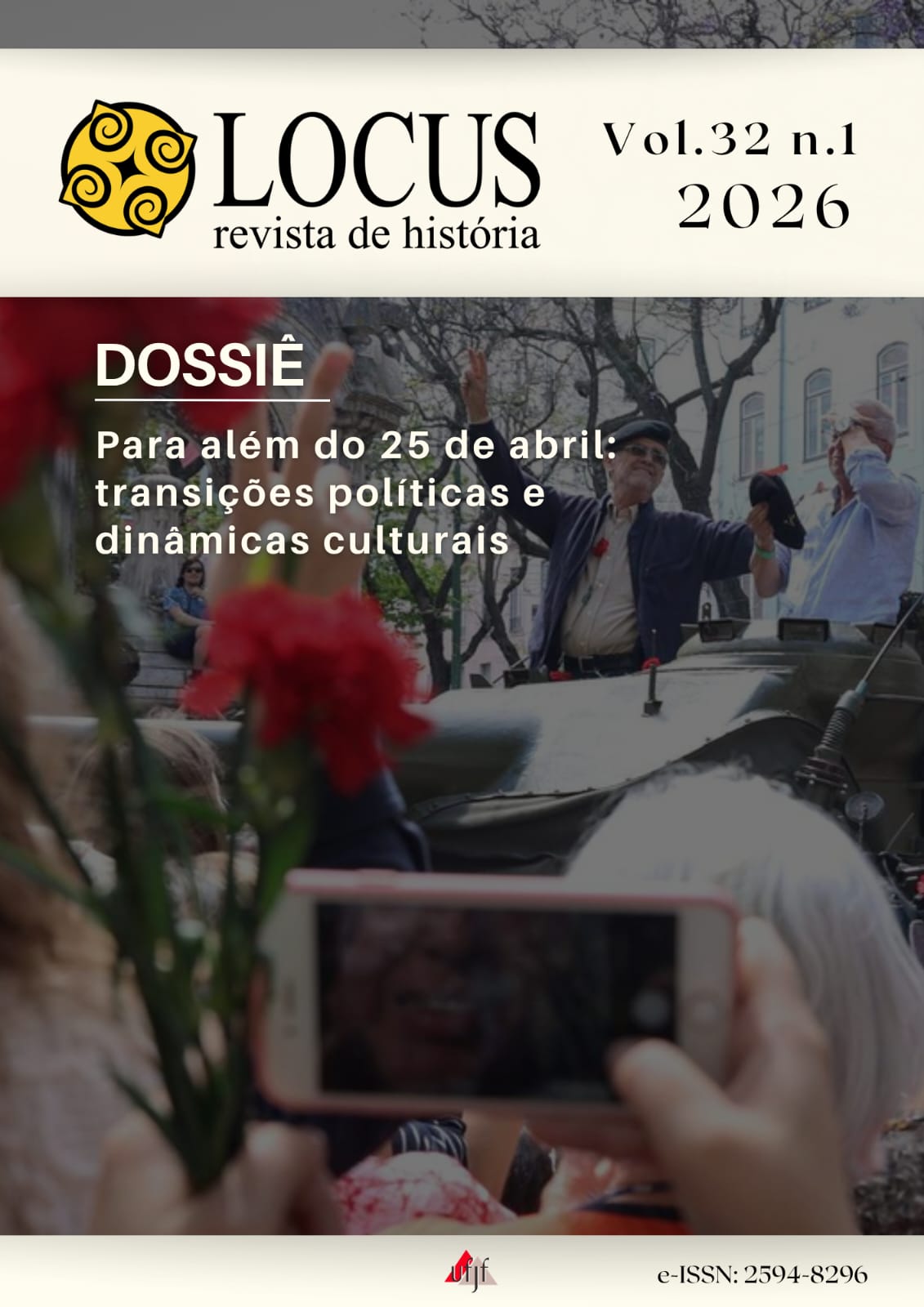
This research focuses on the construction of the Portuguese collective memory of the April 1974 Revolution through a visual and political symbol: the red carnation. More specifically, it sought to understand how the Associação 25 de Abril (A25A) carries out this memorialisation at each annual commemoration, from 1984 to 2025. This analysis followed a post-structuralist perspective, based on Jacques Derrida and Roland Barthes, associated with the theory of the aesthetic turn in International Relations (IR). This theoretical framework has made it possible to decode the complexities of the construction of collective memory and national identity, as well as the (re)significations of the red carnation at each annual commemoration, according to the political and social evolution of Portuguese society. Through a qualitative and visual analysis of the iconographic and typographic elements of the A25A’s annual commemorative posters, the aim was to obtain an overview of the evolution of the visual representation of the red carnation. Thus, it was possible to understand that the red carnation became, associated with the April value of freedom, the great symbol of the 1974 Revolution and the key element in the construction of narrative(s) about it. By linking aesthetic and political approaches through visual methodologies, this study offers new elements for analysis and investigation of international phenomena in the field of IR.
Downloads
References
- Ankersmit, Franklin. Aesthetic politics: Political philosophy beyond fact and value. Stanford: Stanford University Press, 1996.
- Arendt, Hannah. Eichmann em Jerusalém: Uma reportagem sobre a banalidade do mal. Lisboa: Ítaca, 2017.
- Arendt, Hannah. The origins of totalitarianism. Londres: Penguin Books, 2017.
- Assmann, Jan & Czaplicka, John. “Collective memory and cultural identity.” New German Critique, 65 (1995): 125-133. https://doi.org/10.2307/488538.
- Associação 25 de Abril. s.d. “Mensagens, cartazes e medalhas anuais”. https://a25abril.pt/quem-somos/mensagens-anuais/.
- Associação 25 de Abril. s.d. https://a25abril.pt.
- Barthes, Roland. “Éléments de sémiologie”. Communications, 4, 1 (1964): 91-135. https://www.persee.fr/doc/comm_0588-8018_1964_num_4_1_1029.
- Barthes, Roland. “The death of the author”. Em Image Music Text , Stephen Heath, 142-148. Londres: Fontana Press, 1977.
- Barthes, Roland. Mythologies. Paris: Éditions du Seuil, 1957.
- Bebiano, Rui. “Da desmemória e do seu antídoto”. Em Anos inquietos: Vozes do movimento estudantil em Coimbra (1961-1974), Maria Manuela Cruzeiro & Rui Bebiano, 9-13. Coimbra: Edições Afrontamento, 2006.
- Bell, Duncan. “Mythscapes: Memory, mythology, and national identity”. British Journal of Sociology, 54, 1 (2003): 63-81. https://doi.org/10.1080/0007131032000045905.
- Biblioteca de Arte Gulbenkian. 2024. “A poesia está na rua: Cartazes de Maria Helena Vieira da Silva”. https://gulbenkian.pt/biblioteca-arte/read-watch-listen/a-poesia-esta-na-rua/.
- Bleiker, Roland. “The aesthetic turn in international political theory”. Millennium: Journal of International Studies, 30, 3 (2001): 509-533. https://doi.org/10.1177/03058298010300031001.
- Bleiker, Roland. “Aesthetic turn in International Relations”. Em International Relations, Patrick James, 1-13. Oxford: Oxford University Press, 2018. https://doi.org/10.1093/OBO/9780199743292-0236.
- Branco, Isabel Araújo. “25 de Abril sempre! A flor que deu o nome à Revolução: «Um cravo oferece-se a qualquer pessoa»”. Avante, 1378 (2000). https://www.avante.pt/arquivo/1378/7803m4.html.
- Canning, Kathleen. “The politics of symbols, semantics, and sentiments in the Weimar Republic.” Central European History, 43, 4 (2010): 567-580. http://www.jstor.org/stable/40962727.
- Cruzeiro, Maria Manuela. “O 25 de Abril de 1974: Memória da revolução e revolução da memória”. Revista Lusófona de Estudos Culturais, 2, 1 (2014): 25-34.
- Cruzeiro, Maria Manuela & Bebiano, Rui (2006). Anos inquietos: vozes do movimento estudantil em Coimbra (1961-1974). Coimbra: Edições Afrontamento, 2006.
- Dean Cooper-Cunningham. 2020. “Visual methods and international security studies”. https://www.e-ir.info/2020/06/12/visual-methods-and-international-security-studies/.
- Derrida, Jacques. De la grammatologie. Paris: Les Éditions de Minuit, 1967.
- Derrida, Jacques. L’écriture et la différence. Paris: Éditions du Seuil, 1967.
- Derrida, Jacques. Spectres de Marx. Paris: Éditions Galilée, 1993.
- Esquerda. 2018. “Tratado de Maastricht: A sabotagem neoliberal do projeto europeu”. https://www.esquerda.net/artigo/tratado-de-maastricht-sabotagem-neoliberal-do-projeto-europeu/53286.
- Flick, Uwe. An introduction to qualitative research. Londres: Sage, 2018.
- Gedi, Noa & Elam, Yigal. “Collective memory - What is it?”. History and Memory, 8, 1 (1996): 30-50. http://www.jstor.org/stable/25618696.
- Halbwachs, Maurice. La mémoire collective. Paris: Presses Universitaires de France, 1950.
- Halbwachs, Maurice. Les cadres sociaux de la mémoire. Paris: Presses Universitaires de France, 1952.
- Holloway, David. 9/11 and the war on terror. Edimburgo: Edinburgh University Press, 2008.
- Loff, Manuel. “Cavaco e o cavaquismo (II)”, Público, 26 de março de 2016. https://www.publico.pt/2016/03/26/politica/opiniao/cavaco-e-o-cavaquismo-ii-1727226.
- Loff, Manuel. “Depois da revolução?… Revisionismo histórico e anatemização da revolução”. Revista História & Luta de Classes, 12 (2011): 11-16. https://dev.historiaelutadeclasses.com.br/upload/arquivo/2018/03/2372544af4c64d6aea7ebab5761f8463d7ed249c.
- Loff, Manuel. “Dictatorship and revolution: Socio-political reconstructions of collective memory in post-authoritarian Portugal”. Culture & History Digital Journal, 3, 2 (2014): 1-13. https://doi.org/10.3989/chdj.2014.017.
- Medium. 2023. “On the ghosts of Western philosophy”. https://medium.com/deterritorialization/jacques-derridas-specter-s-of-marx-and-the-concept-of-hauntology-reflections-on-deconstruction-2eb687322a69.
- Meagan Paese. s.d. “Flower power”. https://thehistoryofrockandroll.net/flower-power/.
- Moore, Cerwyn & Shepherd, Laura. “Aesthetics and International Relations: Towards a global politics.” Global Society, 24, 3 (2010): 299–309. https://doi.org/10.1080/13600826.2010.485564.
- Moreira, Madalena. “Com menos anos que os seus pares, Chega acompanha tendência europeia: O crescimento da extrema-direita”, Observador, 18 de maio de 2025. https://observador.pt/especiais/com-menos-anos-que-os-seus-pares-chega-acompanha-tendencia-europeia-o-crescimento-da-extrema-direita/.
- Nora, Pierre. “Between memory and history: Les lieux de mémoire”. Representations, 26 (1989): 7-24. https://doi.org/10.2307/2928520.
- Partido Comunista Português. 2024. “Faleceu Celeste Caeiro”. https://www.pcp.pt/faleceu-celeste-caeiro.
- Pereira, Inês. “Tratado de Lisboa: Porreiro? Só para o grande capital”, Abril, 10 de dezembro de 2019. https://www.abrilabril.pt/nacional/tratado-de-lisboa-porreiro-so-para-o-grande-capital.
- Rafter, Kevin. “The political communication of the decade of commemoration”. Studies: An Irish Quarterly Review, 105, 420 (2016): 450-461. http://www.jstor.org/stable/24871507.
- Rancière, Jacques. The politics of aesthetics: The distribution of the sensible. Nova Iorque: Continuum, 2004.
- Rodrigues, Jorge. “1984: A segunda crise depois do 25 de Abril”, Expresso, 2 de abril de 2023. https://expresso.pt/economia/2023-04-02-1984-a-segunda-crise-depois-do-25-de-Abril-a6041316.
- Roudometof, Victor. “Beyond commemoration: The politics of collective memory.” Journal of Political & Military Sociology, 31, 2 (2003): 161-169. http://www.jstor.org/stable/45293737.
- Sapage, Sónia. “25 de Abril de 2020: Uma celebração mais curta e minimalista” Público, 25 de abril de 2020. https://www.publico.pt/2020/04/25/politica/noticia/25-abril-2020-celebracao-curta-minimalista-1913756.
- Schwartz, Barry. “The social context of commemoration: A study in collective memory”. Social Forces, 61, 2 (1982): 374-402. https://doi.org/10.2307/2578232.
- Soeiro, José. “Da geração à rasca ao que se lixe a Troika: Portugal no novo ciclo internacional de protesto”. Sociologia, Revista da Faculdade de Letras da Universidade do Porto, XXVIII (2014): 55-79. https://ojs.letras.up.pt/index.php/Sociologia/article/download/1307/1148/0.
- Tournier, Maurice. “Couleurs, fleurs et drapeaux dans les débuts de la Troisième République”. Mots. Les langages du politique, 81 (2006): 109-117. https://doi.org/10.4000/mots.17093.
- Varela, Miguel. “Processo de Bolonha no ensino superior nacional (2006-2018)”, Jornal de Negócios, 28 de fevereiro de 2019. https://www.jornaldenegocios.pt/opiniao/colunistas/miguel-varela/detalhe/processo-de-bolonha-no-ensino-superior-nacional-2006-2018.